

Views: 0 Author: Site Editor Publish Time: 2026-10-24 Origin: Site


The global footwear market demands rapid scaling and consistent quality. Brand owners and distributors constantly seek reliable avenues to expand their product lines. Partnering with a specialized Original Equipment Manufacturer is undeniably the most efficient route to capture a share of the waterproof footwear sector. A pervasive problem still trips up many procurement teams: not every footwear concept is actually optimized for mass production.
B2B buyers frequently struggle to navigate the harsh realities of the factory floor. A design that functions flawlessly in a small artisan workshop might fail spectacularly when transitioned to an automated injection assembly line. The solution lies in understanding the precise structural, chemical, and logistical characteristics that make a boot viable for industrial scaling. This comprehensive guide will walk you through the essential engineering factors of manufacturing OEM rain boots. You will learn how to select the right polymer compounds, forecast production milestones accurately, and successfully launch a defect-free custom product line.
Recent industry trend analysis highlights a massive shift in global procurement strategies. Driven by the need for supply chain resilience and lower carbon footprints, buyers are rapidly moving away from labor-intensive vulcanized rubber processes. The market is pivoting heavily toward automated injection molding. This transition demands designs specifically optimized for machine tooling, where speed, material efficiency, and seamless construction dictate profit margins.
Material engineering matters: Injection-molded polymers offer the highest cost-efficiency, chemical resistance, and scalability for global distribution.
Customization requires a solid foundation: A robust base mold allows for straightforward modifications in pantone colors, logo embossing, thermal linings, and outsole treads.
Application dictates tooling: The boot's end-use—whether industrial safety, agricultural sanitation, or daily fashion—determines the exact steel mold requirements.
Compliance prevents customs seizures: Buyers must verify their manufacturing partners strictly adhere to international safety and environmental standards like CE, ASTM, and REACH.
Structured processes guarantee yield: Transparent inline inspections and realistic lead times are critical for successful B2B inventory management.
Standard retail shoes often prioritize complex aesthetics over assembly line efficiency. For volume procurement, the focus must shift entirely to manufacturing repeatability and structural simplicity. An optimized design minimizes physical friction and labor dependency on the factory floor.
At the foundational level of footwear manufacturing is the steel or aluminum mold. An OEM-ready silhouette is inherently streamlined. Experienced engineers avoid excessive undercuts, overly complex geometric textures, or sharp internal angles that trap air during injection. Keeping the design simple allows CNC machines to rapidly carve the metal blocks, significantly reducing initial tooling costs. Complex designs requiring multi-part molds inevitably increase the risk of flashing—excess polymer leaking at mold seams. Trimming this flash requires manual labor, which directly inflates your unit cost.
Injection molding machines can produce a fully formed, seamless waterproof boot in mere seconds. This highly automated approach drastically reduces human dependency and minimizes raw material waste. When a large-volume order drops before a tight seasonal deadline, automated lines can run continuously to meet the quota. Traditional hand-laid rubber requires extensive manual rolling and lengthy oven curing times, making rapid scaling nearly impossible during peak demand.
Manual assembly inevitably introduces human error. A slight misalignment in seam stitching or uneven glue application instantly compromises the waterproof barrier. A design optimized for single-piece or dual-density injection molding removes these variables completely. Quality control shifts from monitoring an operator's manual dexterity to calibrating machine temperature, injection pressure, and cooling cycles. Locking in these precise parameters guarantees that the physical dimensions of the ten-thousandth pair match the approved prototype flawlessly.
Selecting the raw material dictates your unit cost, minimum order quantities, and the boot's lifespan in the field. It is the single most critical decision a brand owner makes before opening a mold.
Polyvinyl Chloride, widely known as PVC, is the undisputed industry standard for mass-produced waterproof footwear. It delivers exceptional cost-effectiveness while maintaining an intrinsic resistance to water, thick mud, and agricultural fertilizers. Polymer chemists can engineer specific PVC formulations with advanced plasticizers to resist harsh animal fats and petroleum-based machine oils. For buyers looking for reliable scalability, PVC rain boots provide the optimal balance of structural integrity and aesthetic versatility.
To make an informed procurement decision, you must evaluate how different compounds perform under industrial manufacturing conditions.
Material Type | Engineering Advantages | Manufacturing Limitations | Ideal Commercial Application |
|---|---|---|---|
Rubber | High flexibility, extreme cold resistance, natural slip resistance. | High labor costs, long vulcanization times, heavy physical weight. | Premium hunting gear, specialized extreme-weather logging boots. |
EVA | Ultra-lightweight, excellent shock absorption, high thermal insulation. | Lower puncture resistance, susceptible to shrinkage under high heat. | Casual fashion, lightweight garden clogs, indoor utility wear. |
PVC | Cost-effective, rapid automated injection, superior chemical and oil resistance. | Requires specialized additives to remain flexible in sub-zero environments. | Industrial safety, food processing, daily retail utility footwear. |
A common misconception assumes factory manufacturing results in generic products. Modern facilities actually offer extensive modification options. Buyers can take a proven base mold and re-engineer specific elements to align perfectly with their corporate identity. This strategic customization is exactly how distributors differentiate their private label rain boots in a highly saturated retail market.
Establishing brand presence requires durable logo placement. The most permanent method involves modifying the steel mold to feature an embossed or debossed logo directly on the boot shaft. If your brand requires multi-colored detailing, factories apply high-adhesion printed rubber patches or custom-woven labels immediately post-injection.
Retail recognition relies on color consistency. Reputable manufacturers utilize the Pantone Matching System to create precise color masterbatches. These pigments are mixed with raw polymer pellets before melting. The mold's surface treatment also drastically alters the final product. You can specify a highly polished mold for a glossy finish, or request a sandblasted mold to yield a modern, tactical matte appearance.
The interior cavity offers massive opportunities for value addition. Standard utility boots utilize a basic polyester knit lining. Private label buyers can upgrade this to breathable cotton for humid climates, or integrate faux fur and neoprene for cold-storage thermal insulation. Swapping a flat footbed for a custom ergonomic EVA insole featuring arch support drastically improves all-day operator comfort.
A successful procurement strategy requires aligning technical specifications with the exact pain points of your target demographic. Use this guide to determine your tooling requirements based on the end-user's daily environment.
Footwear destined for mining operations or heavy manufacturing requires rigorous safety integrations. You must select a mold designed with extra internal clearance to house protective hardware. Factories incorporate steel or composite toe caps directly into the injection process to meet 200 Joules impact resistance standards. Puncture-resistant Kevlar midsoles shield the foot from sharp floor debris. The outsole tread must be engineered with specialized nitrile blends to achieve maximum slip resistance on oil-slicked concrete.
Workers in farming or meat processing face constant exposure to animal fats and harsh industrial sanitizers. Boots engineered for this sector require a smooth, self-cleaning outsole tread. The lugs must be spaced widely enough so that organic debris falls out naturally with each step. For food processing facilities, stark white PVC formulations are universally required to easily identify cross-contamination.
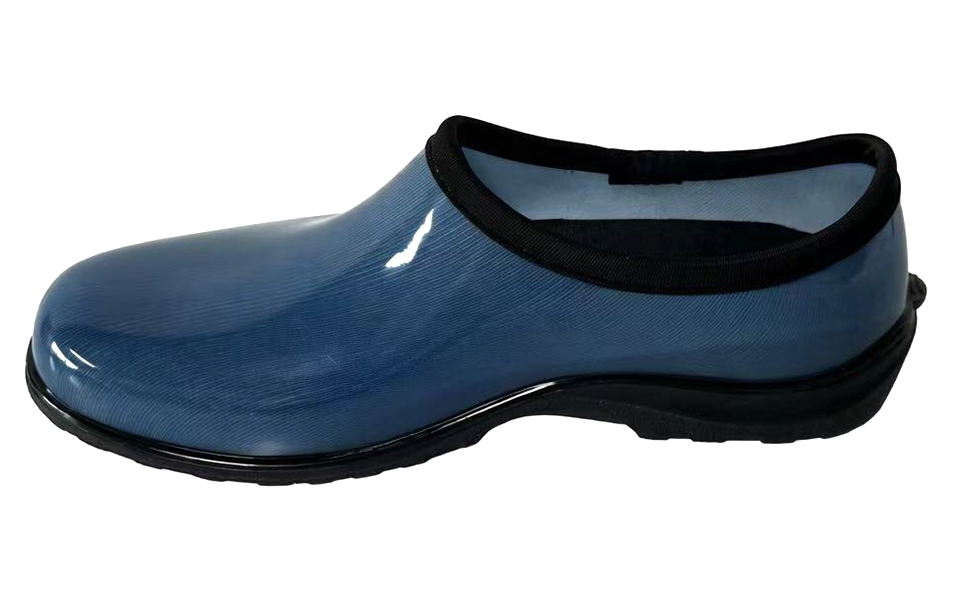
Consumer-facing retail brands prioritize aesthetic appeal and walkability over heavy-duty crush protection. Designs for this sector focus heavily on weight reduction and vibrant color combinations. For example, lightweight garden clogs utilizing flexible PVC material and an easy-clean, slip-on design ensure all-day comfort while shedding mud effortlessly. Buyers developing these lines should prioritize flexible polymers and breathable linings that guarantee retail shelf appeal.
Importing footwear involves navigating a minefield of international regulations. Partnering with a factory that actively maintains compliance records is non-negotiable to prevent costly customs rejections.
Boots marketed as Personal Protective Equipment must pass independent laboratory testing. European safety boots must comply with the CE EN ISO 20345 standard. The United States requires adherence to ASTM F2413. Your OEM partner must provide verifiable documentation proving their current production batches consistently pass tests for impact, compression, and electrical hazard resistance.
Customs agencies heavily scrutinize chemical compliance. The European Union REACH regulation strictly limits harmful substances in consumer goods. Procurement teams must ensure that all raw materials, particularly PVC compounds and color dyes, are entirely free from restricted phthalates, lead, and heavy metals. Reputable manufacturers source certified raw materials and readily provide chemical test reports from agencies like SGS.
B2B procurement relies on highly structured project management. Expect a transparent, milestone-driven process when engineering a new footwear line.
The process initiates with a comprehensive Tech Pack. This master document details 2D and 3D CAD drawings, exact polymer requirements, Pantone codes, lining specifications, and a complete size grading chart. Clear engineering communication here prevents catastrophic errors later.
Once the Tech Pack is approved, tooling begins. CNC machines carve the precise shapes from metal blocks. The factory then injects a Pre-Production Sample. You must physically review this sample to approve the fit, color accuracy, and surface finish before authorizing bulk manufacturing.
Upon sample approval, mass production commences. This involves material compounding, injection molding, lining assembly, and final trimming. Quality control cannot wait until the end. Technicians must perform inline inspections continuously on the factory floor to monitor machine temperatures and material flow, catching defects in real-time.
The final milestone is rigorous Quality Assurance. Batches undergo pneumatic water-leak testing to guarantee absolute waterproofing. Visual inspectors check for flash and proper logo alignment. The boots are then packed according to your exact retail specifications, complete with custom shoeboxes and barcode labels, ready for international freight.
Time to market dictates seasonal retail success. Accurate procurement forecasting prevents devastating stockouts during peak rainy or winter seasons.
Developing a brand-new, customized mold is the most time-consuming variable, typically adding twenty to thirty-five days for CNC machining and calibration. Material sourcing also impacts the schedule. While standard black or green polymers are abundant, custom Pantone color matching or specialized safety toe caps require ten to fifteen days of inbound supply chain time.
For effective inventory planning, adhere to these baseline estimates. Utilizing the factory's existing tooling with simple color changes generally takes thirty to forty-five days after sample approval. If your project requires opening new molds, full size grading, and extensive third-party safety testing, expect the end-to-end process from concept to shipment to range from sixty to ninety days.
Engineering the right boot for factory manufacturing requires a strategic balance of material efficiency, targeted customization, and strict adherence to global safety standards. Automated injection-molded polymers provide unparalleled durability and exact cost control, making them the superior choice for large-scale production. By partnering with a facility that offers transparent timelines, robust compliance records, and structured quality assurance, brand owners can confidently scale their global operations.
Clear technical communication and a deep understanding of your end-user's environment ensure your product launches without a hitch. Start evaluating your supply chain parameters today, and explore high-quality PVC rain boots to build a profitable, resilient footwear portfolio.
Order minimums vary depending on the facility's scale and the complexity of the design, but they generally range from 500 to 1,000 pairs per color or style. This volume is mathematically necessary to offset the high costs of heating up injection molding machines, purging previous colors from the system, and bulk-dyeing raw polymer pellets.
Tooling costs depend entirely on the geometric complexity and the total size run required. A new steel mold can range from a few hundred to a few thousand dollars per shoe size. Many established factories offer mold fee rebates, refunding the initial tooling cost once a buyer's cumulative order volume reaches a pre-agreed threshold.
Yes. Material science has advanced significantly. Modern facilities produce footwear using highly recyclable polymer compounds. Reputable manufacturers utilize non-toxic formulations that completely eliminate harmful phthalates and heavy metals, ensuring the product is safe for both the environment and the operator.
Injection molding involves melting polymer pellets and forcing them into a closed mold under high pressure, creating a seamless, highly durable boot in seconds. Vulcanization involves manually wrapping layers of uncured rubber over a foot-shaped last, then baking it in a large oven to cure. Injection molding offers faster scaling, lower costs, and zero seam-leakage risks, while vulcanized rubber offers superior extreme-cold flexibility.
Top-tier factories utilize pneumatic water-leak testing. Technicians submerge the finished boot in a water tank and pump compressed air inside. If any bubbles appear, the boot fails the inspection. You should always request that your manufacturing partner includes this pneumatic testing protocol in their standard inline quality assurance process.
A standard order generally falls within a forty-five to ninety-day window. Utilizing an existing factory mold with standard materials allows production completion in as little as thirty to forty-five days. Projects requiring custom mold creation, specialized safety laboratory testing, and custom retail packaging will push the timeline closer to ninety days.
No, safety hardware cannot simply be retrofitted into a standard retail mold. Safety boots require specific, dedicated molds engineered with extra internal volume to house the protective toe cap without pinching the wearer's foot. If you require impact protection, you must select a base model explicitly designed for industrial use or invest in new safety-specific tooling.


